
Bonner Scheduled Versus Actual Release
The Bonner County Sheriff's current PDF can display a field labeled Scheduled Release. That field belongs to a person who is still listed in the current jail report. It is planning information, not a record that the jail door opened on that date. The actual release date and time appears in the completed custody movement or release record held by the sheriff. A transfer also ends the Bonner booking, but it does not mean the person returned to the community.
A pretrial detainee often has no set release date. Bond may change, a judge may enter an order, a warrant may surface, or another agency may lodge a hold. A person serving a county sentence may have a date based on the judgment and jail calculation, yet other cases or holds can affect the outcome. Never fill a blank or masked Scheduled Release field by doing your own math.
Find a Bonner Release Date
Start with the last known custodian. The Bonner County Sheriff's detention page links the current inmate report. It can answer whether someone was listed when the PDF was generated and whether a Scheduled Release value appeared. The report is overwritten and has no public actual-release ledger, so save the report time and use the next source that matches the case.
- Confirm identity with full name, birth year, booking or IDOC number, case number, and approximate custody dates.
- Check the current Bonner report. Treat Scheduled Release as prospective and absence as inconclusive.
- For a state sentence, use the IDOC Resident/Client Search and preserve each exact date label.
- Read the Idaho iCourt Portal case for the judgment, sentence, bond, and later orders.
- Call Booking at 208-263-8417 ext. 3005 for current operational status. Request the completed release record from Sheriff's Records when proof is needed.
- If another agency received the person, continue with that agency. A custody handoff is not community release.
The broader Bonner County released inmate search explains how to trace county, state, federal, and immigration custody. The release-date task is narrower: identify the official label, determine whether it is planned or completed, and obtain the record that supports it.
A short county sentence and an IDOC sentence require different routes. Someone who posts bond or completes a local term may never appear in IDOC at all. In that case, a failed state search says nothing about the Bonner County release date. Use the sheriff's completed custody record and match it to the court case. By contrast, a person committed to IDOC may leave the Bonner jail as a transfer, later appear “In custody” at a state prison or county-jail contract location, and only later move into the community. The first movement ended the county booking but was not a community release.
Bonner and IDOC Date Labels
Bonner County and IDOC do not use one shared “projected release date.” The county report's Scheduled Release concerns a current local booking. IDOC detail pages can display Parole Eligibility Date, Sentence Satisfaction Date, and Released to Supervision. Each answers a different question. Copying one value into another label can turn a correct record into a false claim.
| Official label | What it means | What it does not prove |
|---|---|---|
| Scheduled Release | A prospective date shown on a current Bonner jail row | That physical release occurred |
| Parole Eligibility Date | When ordinary parole consideration may begin under the sentence | That parole will be granted or implemented |
| Sentence Satisfaction Date | IDOC's calculated endpoint for the active sentence | A guaranteed prison exit on that date |
| Released to Supervision | The most recent placement on a supervision period | Final discharge from the sentence |
| Discharged with date | The displayed IDOC sentence has been satisfied | The exact Bonner jail exit time |
The official IDOC detail example shows the status and sentence fields in their agency context.
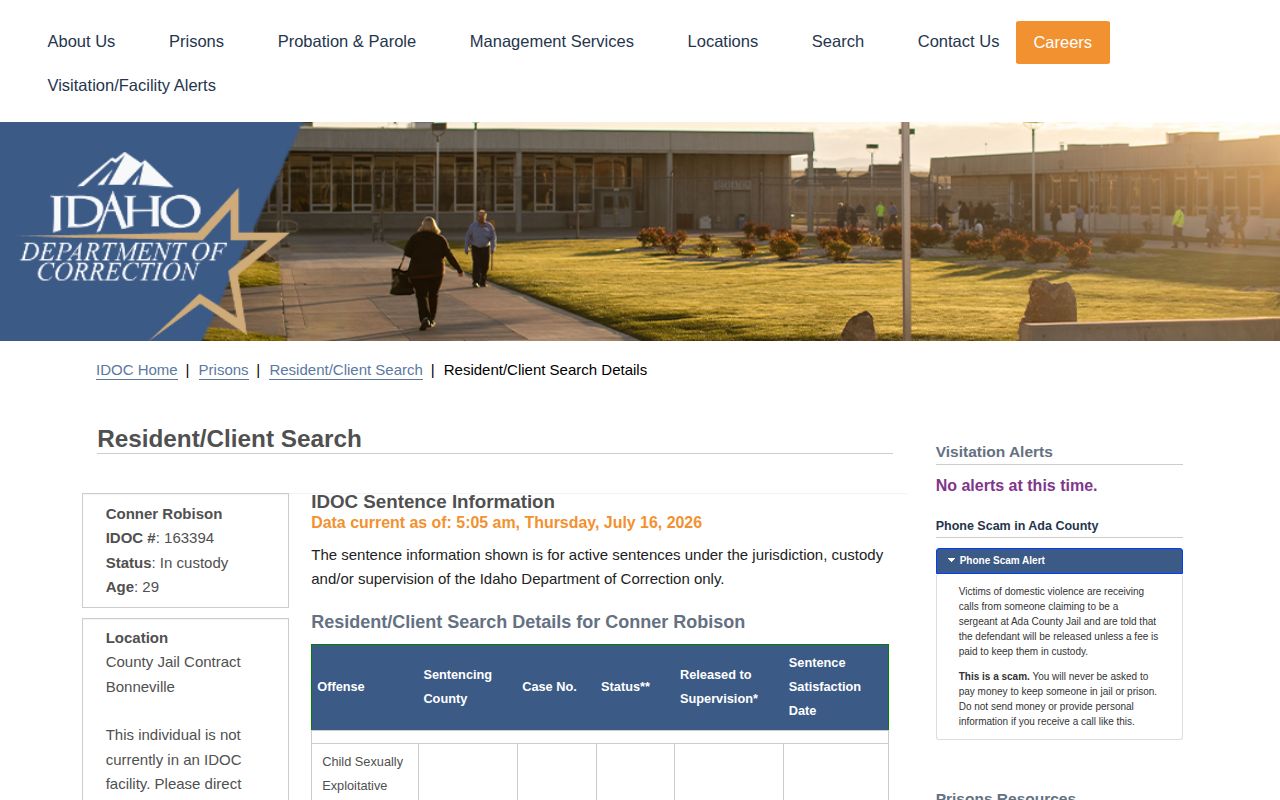
The image demonstrates why status, supervision placement, satisfaction, and eligibility must be transcribed separately rather than reduced to one release date.
Idaho Sentences Shape Release Dates
Idaho uses a unified sentence. Under Idaho Code section 19-2513, the court states a fixed minimum period and may add an indeterminate period. The fixed part is the ordinary parole-eligibility anchor. It is not the same as the full sentence endpoint. The Commission of Pardons and Parole may consider an eligible person, but parole is conditional and discretionary.
There is no universal Idaho rule that every state prisoner serves 85 percent. That shorthand should not be imported from the federal system or another state. Offense rules, enhancements, consecutive sentences, life terms, sex-offense provisions, and the actual judgment can alter eligibility. The controlling sources are the signed judgment, IDOC's calculation, and any Commission action.
Idaho also does not supply routine day-for-day good time that can safely be subtracted on a public page. Section 20-101D permits a narrow reduction for extraordinary heroism or outstanding service, such as saving life or preventing escape. It is not a standard earned-time formula. A separate medical-parole provision covers qualifying severe medical cases. Neither creates a date promise.
What Changes Bonner Release Dates
An agency-calculated date rests on the court judgment, sentence structure, lawful custody credit, and current case status. New facts can move it. Some events delay a community release. Others change eligibility or end a booking through transfer rather than discharge.
| Factor | Possible effect | Source to verify |
|---|---|---|
| Court order or amended judgment | Changes bond, credit, term, or release authority | iCourt and certified clerk record |
| Concurrent or consecutive sentences | Changes how several terms overlap or follow each other | Judgment and IDOC Sentencing Records |
| Detainer, warrant, or other hold | May block community release or cause transfer | Custody record and receiving agency |
| Commission parole decision | May grant, deny, or continue parole consideration | Commission Notice of Action Taken |
| Program and plan requirements | Can delay implementation of a tentative parole date | Commission and IDOC record |
| Appeal or recalculation | Can revise sentence data or credits | Court and IDOC Sentencing Records |
A Commission decision may say “Grant Parole” and show a tentative date. Required programming, an approved parole plan, and final paperwork can still stand between that decision and release. Check IDOC after the event for “In community” and Released to Supervision. If the decision says parole to a detainer only, follow the receiving custodian instead.
The Commission hearing calendar and its later Notice of Action Taken belong to a separate stage of the timeline. Hearing sessions occur in Boise during a two-to-three-week period each month, and the published outcomes may grant parole to a tentative date, deny it, continue the matter, or pass a person to the full term. Eligibility under the judgment creates an opportunity for consideration, not a right to leave custody. After any favorable action, compare the IDOC number and case number, then wait for the state record to show the later status change. This prevents a hearing result from being reported as a completed Bonner County or IDOC release.
Bonner Planned-Date Information Gap
Bonner County has a distinctive records gap. The sheriff may expose a planned date in a current row while offering no public list of completed releases from the last 24 or 72 hours. Archived PDF snapshots do not repair that gap. Each one shows who appeared current at a report time, and comparing snapshots can miss short bookings or misclassify a transfer.
After the planned date passes, ask Sheriff's Records for the actual date and time custody ended, the disposition or reason code, releasing authority, and destination or receiving agency. Send the request to the Bonner County Sheriff's Office at 4001 N. Boyer Road, Sandpoint, ID 83864, or use the county public-records request page. The county and sheriff pages have displayed two records email domains, so use the address printed on the live form or call before sending.
Under Idaho's current public-records framework, a resident request generally receives a grant or denial within three working days, with written extension notice allowing up to ten working days. No fixed Bonner fee for this release record was found. Ask for an estimate if search or copying costs may apply.
Request an existing release screen, custody-history entry, booking jacket, or daily release record. Give a narrow date range and ask for the native electronic form. Useful fields include the booking number, actual exit timestamp, release disposition, code definition, releasing authority, and receiving agency. This wording asks for records the jail already keeps rather than requiring staff to create a new calculation. If an exemption applies to part of the file, nonexempt release fields may still be segregated and produced.
Confirm Bonner Release Dates
Use Idaho VINE as an alert layer when a future custody change matters. Registration options can include phone, text, email, or more than one channel. Telephone registration may require a four-digit PIN and acknowledgment. The live interface controls the available events. A VINE notice can point to a change, but it is not a certified calculation or release record.
The VINE Inmate Check workflow explains how to search and register. For same-day status, contact the custodian. For a disputed state calculation, use IDOC's Request for Information or Sentencing Records. For a completed Bonner jail event, use the sheriff's custody record. Keep the court order, planned date, and actual exit in separate sentences.
The strongest confirmation pairs the agency-produced release entry with the judgment or order that explains it. An official IDOC Discharged result can confirm the displayed state sentence ended, while an “In community” result indicates supervision rather than final discharge. A Commission decision proves what the Commission decided, not that staff completed release. Roster disappearance, a missed alert, or a past planned date remains only a clue until the custodian's record resolves the event.
- Projected or scheduled
- A date calculated or planned before the event and subject to change.
- Actual release
- The completed end of a specific custody episode, with a date, time, and disposition.
- Parole
- Conditional community release approved by the Commission after eligibility.
- Discharge
- Satisfaction of the sentence obligations shown by the correctional agency.
- Detainer
- A request or authority for another agency to assume custody.
Note: A “not found” result never proves release. Record the system, search terms, and date, then check the responsible agency.