
Preserve each IDOC and Commission date under its original label and as a separate event.
IDOC Bonner Release Search
The IDOC Resident/Client Search covers people under Idaho felony correctional jurisdiction, including incarcerated residents and probation or parole clients. It also retains the names of former clients after sentence satisfaction, although IDOC says satisfied convictions no longer appear. That feature makes the state system useful after a person has left prison. It is not a replacement for the Bonner County Sheriff’s release record when the person had only a county-jail booking.
Begin with the last known custodian. A person sentenced to IDOC can leave the Bonner County Sheriff’s Detention Center for a state prison or a county-jail contract placement. That movement is a transfer, not release to the community. A short county stay ending in bond, dismissal, time served, or a local order may never create an IDOC record at all. In that case, use the Sheriff’s custody history and the iCourt case.
Search Idaho Release Status
IDOC permits a name search or an agency-number search. Enter at least two characters of the last name, with the first name optional, or enter at least the first three digits of the IDOC number. Open the matching detail only after comparing the birth year and agency number. Common names can produce several results, and a similar name is not enough to join a state record to a Bonner County case.
- Search the person in the statewide Resident/Client Search.
- Match IDOC number, name, middle name, and birth year.
- Read the overall status before interpreting any sentence row.
- Compare sentencing county and case number with iCourt.
- Record the exact agency labels and the date checked.
The project manifest captures the official search fields and daily-update warning shown below.
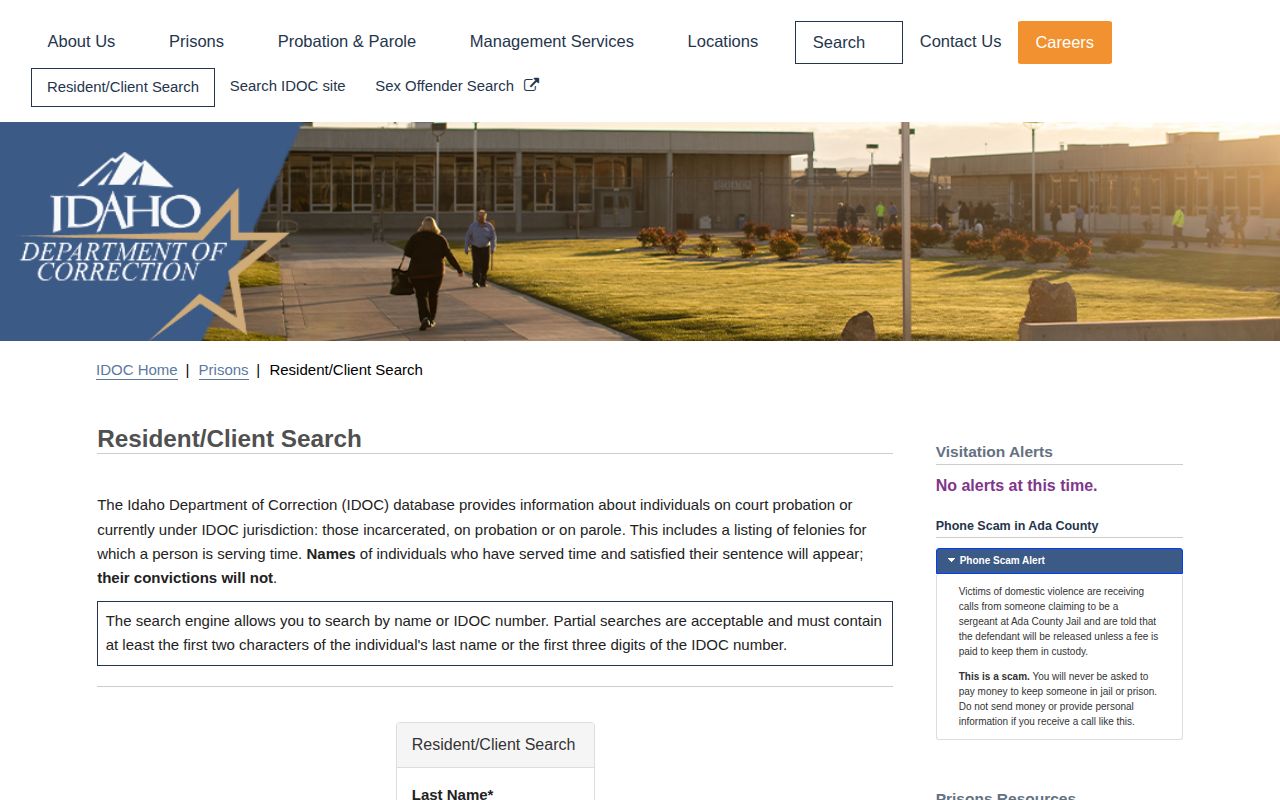
The image shows why a focused identifier search is stronger than relying on a broad name match. IDOC updates daily, but it warns that status, location, and scheduled termination information can change quickly.
IDOC Release Status Meanings
The results use four observed overall categories. They must remain in the agency’s own words. A state record may also contain several sentence rows, concurrent or consecutive cases, and a location that changes while the overall status stays the same. Read the full detail rather than extracting one date.
| IDOC label | What it establishes |
|---|---|
| In custody | The person remains confined under IDOC jurisdiction, including possible contract placement. |
| In community | The client is outside prison but remains on felony probation or parole supervision. |
| Discharged [date] | The displayed IDOC sentence was satisfied on the stated date. |
| Active Bench Warrant | A supervision matter is unresolved; it is not discharge or proof of a specific jail location. |
“In community” is a release from secure prison custody, but it is not the end of state jurisdiction. “Discharged” is the state-system endpoint. “In custody” at a county-jail contract location still means state custody. An Active Bench Warrant requires confirmation through the responsible correctional or court channel and cannot be converted into a claim of present confinement.
IDOC Bonner Record Fields
An active detail can show age, location or supervising district, offense, sentencing county, case number, sentence status, Released to Supervision, Sentence Satisfaction Date, and sometimes Parole Eligibility Date. Each field has a narrow role. Sentencing county and case number help link the right Bonner County judgment. Location identifies the present institution, contract site, or district as IDOC displays it. The sentence row explains which term the dates belong to.
- Released to Supervision
- The most recent placement on a supervision period by a court or the Parole Commission.
- Sentence Satisfaction Date
- The calculated endpoint for the active state sentence, not a county-jail departure time.
- Parole Eligibility Date
- The point when parole consideration may begin, not a promised release.
- Discharge
- Completion of the correctional sentence and IDOC jurisdiction shown in the result.
The official IDOC detail model shown below demonstrates those distinct fields.
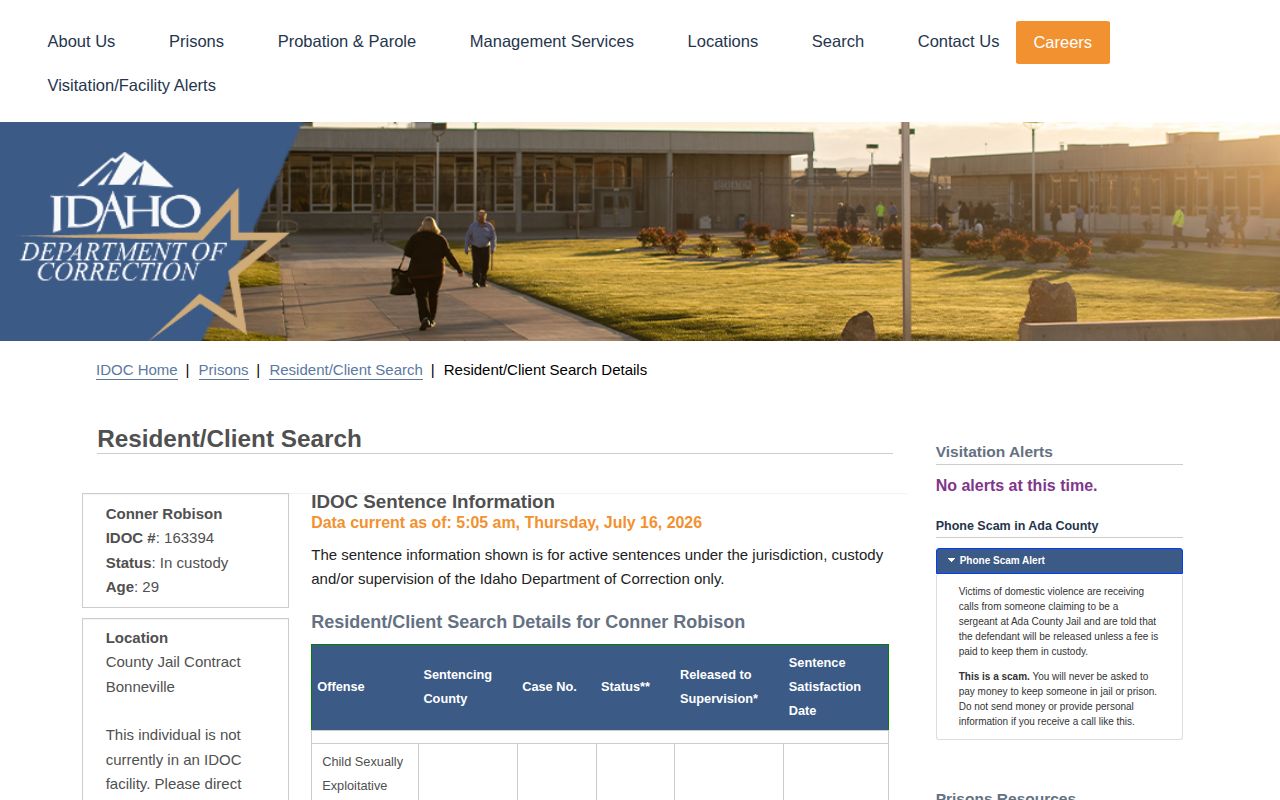
The screenshot is a field example, not evidence about a particular Bonner County release. Its value is the agency vocabulary, especially the separation between supervision placement and final sentence satisfaction.
Bonner Transfers Into IDOC
No IDOC prison was identified inside Bonner County. This facility page therefore describes a statewide system serving Bonner commitments, not a local prison building. After a felony judgment, a person may remain for a time at the county jail, move to an IDOC institution, or appear at a county-jail contract location. The detail record’s location and status determine which part of the state system currently holds jurisdiction.
A disappearance from Bonner’s Current Inmate Offense List does not prove a state release. If IDOC later displays “In custody,” the better description is transfer from county custody into state custody. If the record later changes to “In community” and provides Released to Supervision, the person is outside prison on probation or parole. A later “Discharged [date]” result documents final state sentence satisfaction as IDOC displays it.
For documentary confirmation, preserve the Bonner booking number and iCourt case, then use IDOC’s Request for Information or Sentencing Records route. The county cannot certify an IDOC discharge, and IDOC cannot certify the exact physical exit time from the Bonner jail.
IDOC Release Date Vocabulary
Idaho does not publish one universal field labeled Projected Release Date in the public detail template reviewed. Sentence Satisfaction Date, Parole Eligibility Date, Released to Supervision, and a Commission tentative parole date answer different questions. The Bonner jail’s separate Scheduled Release field is also not an IDOC parole date. Substituting one label for another can create a false release claim.
Under Idaho Code section 19-2513, a unified sentence includes a judicially fixed minimum and may include an indeterminate portion. The fixed portion is the ordinary parole-eligibility anchor. Idaho should not be described with a universal 85-percent rule. Parole remains discretionary, and sentence structure, credit, consecutive matters, detainers, court action, and later recalculation can affect the dates IDOC displays.
The Idaho Commission’s published parole date is tentative. A grant does not prove physical release. Check for a later IDOC “In community” status and Released to Supervision field, then obtain sentencing records when the exact implementation date matters.
Verify IDOC Discharge Records
Use a layered check when a Bonner County connection must be confirmed. Match the IDOC identity first. Compare sentencing county and case number to iCourt. Read every active sentence row. If the result says Discharged, record the date and note that satisfied convictions may no longer appear. If it says In community, use the supervising district for routing rather than calling the Bonner jail.
IDOC headquarters is at 1299 N. Orchard Street, Suite 110, Boise, ID 83706, and the main number is 208-658-2000. Use the online Request for Information channel for an error or additional state record. For local felony supervision, the linked IDOC District 1 Sandpoint page explains Sandpoint and Coeur d’Alene routing. For a local booking release instead, return to the Bonner County Sheriff’s Detention Center.
Note: Record the exact IDOC status and check date instead of inferring a broader result from a missing sentence row.
Bonner State Record Proof
A public search result is a strong orientation record, but a formal question may require more. Save the IDOC number, exact status, search date, sentencing county, case number, and each date label without rewriting the labels. Then request the existing state record from IDOC. A narrow request can seek the relevant sentence calculation, supervision placement, discharge entry, or correction of a specific field. It should not ask staff to create a new narrative or decide what a separate Bonner County record means.
Reconcile the response with the judgment. The court establishes the sentence and later orders. IDOC administers the state sentence and reports custody, community supervision, and discharge. The Commission decides parole, while District 1 carries out community supervision. This chain explains why a Commission grant, an IDOC eligibility date, and an actual release to supervision may occur at different stages.
A “no result” is never final proof. Retry spelling, prior names, and the IDOC number. Check whether the matter was solely a county case. Records may also change because the agency corrects data or because satisfied conviction details are removed from the public result. State only what the named source showed on the date checked. That preserves the difference between a search outcome and a verified discharge record.
Public Record Search
Sponsored Results