
Detention Center Release Routes
The Bonner County Sheriff detention page identifies the center as the county’s adult jail. A person may leave after posting bond, receiving a court order, serving a local term, or entering a supervised program. Those events may return the person to the community. Other departures are transfers. Commitment to the Idaho Department of Correction, movement to another county, or pickup under federal or immigration authority ends physical custody at Boyer Road without ending custody as a whole.
The release disposition and destination are therefore central. “Released” on a local custody-history entry can describe the end of the Sheriff’s segment. It does not always mean free from every agency. Use the Idaho iCourt Portal to read the order or judgment, then check IDOC, BOP, ICE, or the named receiving jail when the Sheriff record shows a transfer.
| Departure | Best confirmation |
|---|---|
| Bond or court order | Sheriff release timestamp plus court docket |
| Local sentence completed | Custody history and judgment |
| IDOC commitment | IDOC Resident/Client Search after intake |
| Federal or ICE pickup | Destination field plus the correct federal channel |
Confirm Bonner Jail Release
The Sheriff publishes a Current Inmate Offense List. It can show incarceration data, charges, bond, and a field labeled Scheduled Release. It does not publish an official list of people who actually left in the prior day or three days. A missing name is only a lead because a transfer, correction, or other movement can also remove a person from the current list.
- Open the latest list from the Sheriff detention page and record its generation time.
- If the person appears, read Scheduled Release only as a prospective field. Do not call it an actual exit time.
- Call Booking Information for a current operational check when the event is recent.
- Request the existing release or custody-history entry when documentary proof is needed.
- Match the booking and case number in iCourt, then check any receiving agency named by the Sheriff.
The full Bonner County released-inmate search path explains how the separate records fit together. VINE may add a custody-event notification, but it does not replace the custodian’s formal date, reason, or destination.
Detention Center Release Records
For an immediate status check, call Bonner County Sheriff Booking Information at 208-263-8417, extension 3005. For a document, send a narrow request to Sheriff’s Records. Identify the full name, known name variants, date of birth or booking number when lawfully known, and a short booking-date range. Ask for the actual date and time custody ended, the release disposition or reason code and its definition, the releasing authority, and the destination or receiving agency if a transfer occurred.
4001 N. Boyer Road
Sandpoint, ID 83864
208-263-8417, Booking ext. 3005
Fax: 208-265-4378
records@bonnercountyid.gov
Main posted hours: Monday–Friday, 8 a.m.–5 p.m.
The county’s public-record request page provides forms and routing. The county directory and the live Sheriff form have displayed two different records email domains. Use the address on the current form being submitted or call Booking to confirm delivery. Ask for electronic records in their native format and a cost estimate before paid work. No fixed Bonner fee for this release record was verified.
Bonner Jail Record Fields
A focused request is more useful than asking the agency to research what happened. Request existing fields. The custody entry may identify the booking, actual release timestamp, release reason, court authority, or receiving agency. The public PDF does not supply dependable completed-event fields, even when it displays a planned date.
- Scheduled Release
- A prospective value on the current report, not proof of departure.
- Actual release time
- The recorded time the Sheriff’s custody segment ended.
- Release disposition
- The agency code or description for bond, court order, sentence completion, or another event.
- Transfer destination
- The agency or facility that received the person, if custody continued.
Idaho Code sections 74-102 and 74-103 govern requests, eligible costs, response timing, and written extensions. Exempt material may be redacted while nonexempt portions are released. Juvenile, medical, victim, witness, and protected investigative information should not be included in an adult custody request.
Inside the Bonner Detention Center
The Sheriff reports that the facility opened in 1998. It has capacity for 124 prisoners and an average daily population of about 85. The official description includes two pods, lock-down, dormitory, high-security, medical, female, holding, and work-release areas, along with a transportation section. These are sourced operational facts, not an annual-release count.
The facility description helps explain why a name can move between categories or systems. It does not disclose a complete public history after the booking closes. The official detention page shown below supplies the facility description and current-roster route.
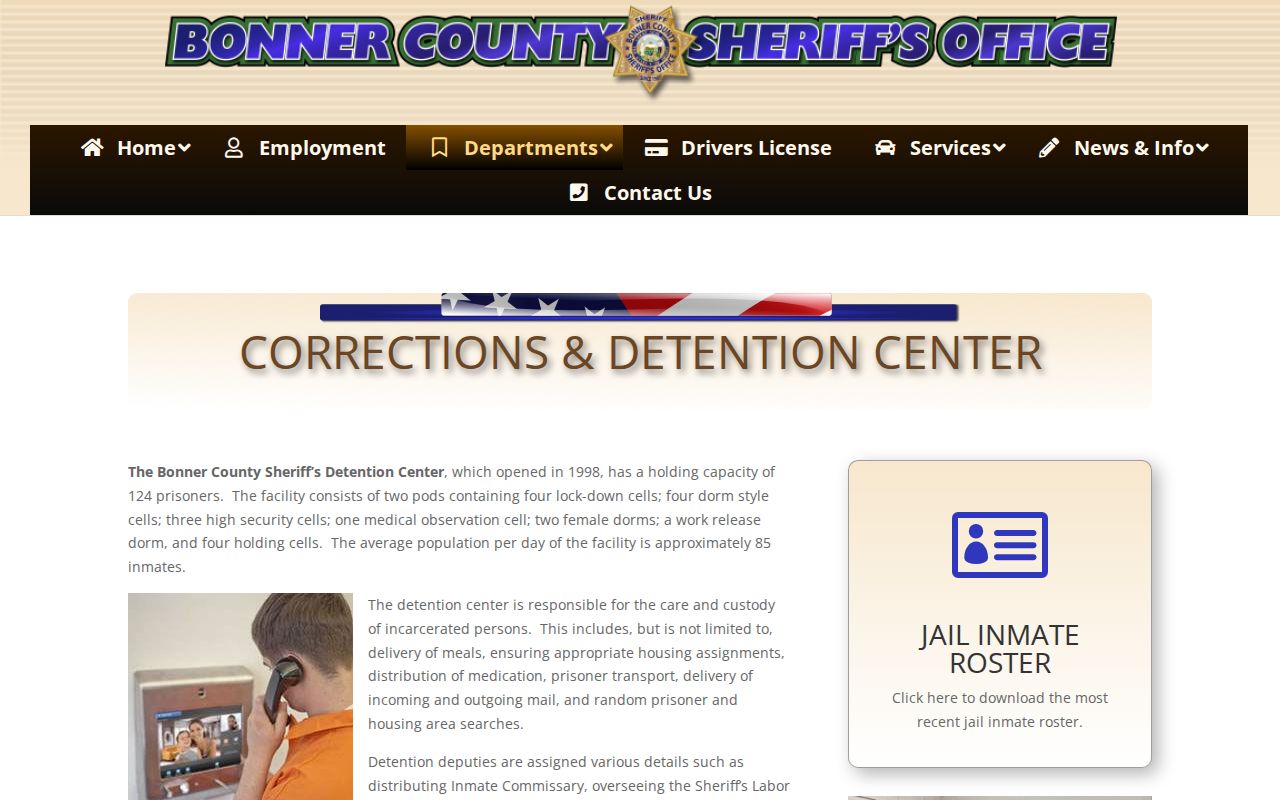
The image points readers to the current-custody source; completed Bonner release facts still come from Booking and Records.
A 1998 Jail with Work Release
The 1998 center includes a work-release dorm, and the Sheriff describes labor and work-release programs. Work release can permit approved movement for work while a person remains subject to jail rules and legal custody. It is not the same as sentence satisfaction, IDOC discharge, or an unrestricted return to the community.
When a record uses “work release,” ask whether the booking remained active and what order governed the program. The court docket can explain authority and conditions. The Sheriff’s custody history establishes when the jail term actually ended. This facility-specific detail prevents a common error: treating physical time outside the building as proof that all custody ended.
The physical layout also explains why the current list can include people with different custody-area or program classifications. A work-release participant may spend approved periods away from the building and still remain in the Sheriff's custody. Conversely, a person who leaves Boyer Road in a transport vehicle may have ended local custody but entered IDOC, federal, immigration, or another county's custody. Neither observation establishes community release without the disposition and destination fields.
After a Bonner Jail Transfer
A person committed on an Idaho felony case should be searched in the IDOC Resident/Client Search after intake. “In custody” at an IDOC or contract location means confinement continued. “In community” describes probation or parole supervision, while “Discharged” with a date reflects sentence satisfaction in the state system. These labels must not be substituted for one another.
No IDOC prison was identified inside Bonner County. Even so, an IDOC client may appear at the county jail as a County Jail Contract placement before moving elsewhere in the state system. That label identifies continued state jurisdiction at a local location. It does not convert the placement into release, and it does not establish that the person returned to a Bonner County address.
For a federal sentence, use the BOP locator. For an immigration handoff, use ICE’s locator and ERO channels. USMS pretrial custody has no comparable public person locator, so the federal court, counsel, or district office is the route. The Sheriff record should be preserved because it links the Boyer Road booking to the next custodian.
Compare the local disposition with the receiving system rather than treating either record alone as the complete history. The Sheriff can document when its custody ended and where the person was sent. The receiving agency can establish whether confinement continued after that handoff. The court judgment supplies the legal authority for an Idaho commitment, while IDOC supplies the later correctional status.
Note: A transfer closes local custody but is not a community release.
Keep Facility Records Purpose-Neutral
Booking, charge, warrant, and release entries describe different events. An arrest or booking photograph is not proof of conviction, while a release timestamp does not erase or decide the court case. Use iCourt for the judicial disposition and the Sheriff's record for the physical custody event. When names or birth details are similar, reconcile the booking number and case number before drawing a conclusion.
Juvenile information, medical details, victim and witness data, and protected investigative material can be confidential or redacted. A focused request for administrative release fields gives Records a chance to separate responsive public material. If something is withheld, request the applicable statutory basis rather than assuming the entire booking file must be public.
Record when each source was checked. The Sheriff's PDF is overwritten, and no published post-release visibility period was found. An archived current-list snapshot proves only that a person appeared at that snapshot time. It cannot supply the actual exit time, the reason custody ended, or the destination. Preserve the responsive custody entry and its code definitions when the distinction matters.