
Bonner County Supervision Types
Parole is conditional release from an Idaho prison sentence. The Idaho Commission of Pardons and Parole makes the release decision, while the Idaho Department of Correction supervises the person in the community. Probation is a court-ordered sentence served in the community. IDOC supervises felony probation. Bonner County Justice Services handles adult misdemeanor probation. These paths are not interchangeable.
| Status | Decision maker | Supervising office |
|---|---|---|
| Felony parole | Idaho Commission of Pardons and Parole | IDOC District 1 |
| Felony probation | Sentencing court | IDOC District 1 |
| Adult misdemeanor probation | County court | Bonner County Justice Services |
Verify Bonner County Supervision
The official starting point for a state felony case is the IDOC Resident/Client Search. It accepts a last name with an optional first name, or an IDOC number. Results distinguish In community, Discharged with a date, In custody, and Active Bench Warrant. A detail page may identify the supervising district, office, officer, Released to Supervision date, Sentence Satisfaction Date, and Parole Eligibility Date.
- Search by the full name or IDOC number and compare the birth year.
- Open the matching detail record and read the overall status.
- Confirm that the sentencing county and case number fit the known case.
- Use the listed district or office, not a guessed local office.
- For misdemeanor probation, contact Bonner County Justice Services instead.
- For documentary proof, request the record from the agency that owns it.
IDOC says its data updates daily and can change fast. A same-day question should be confirmed with the responsible office. A missing result does not prove that no supervision exists.
Bonner County District 1 Office
Felony clients in the Sandpoint area are routed through IDOC District 1. The state detail record is the best way to confirm the current office because assignments can change.
1013 Lake Street, Suite 101
Sandpoint, ID 83864-0905
208-263-0455
Fax: 208-263-3251
The District 1 main office is at 202 E. Anton Avenue, Suite 100, Coeur d'Alene, and its phone is 208-769-1444. Adult misdemeanor cases go to Bonner County Justice Services, not IDOC. Justice Services also operates juvenile probation, but juvenile information is generally confidential.
Bonner County Warrant Layers
An IDOC result marked Active Bench Warrant concerns the state supervision record. It does not establish that the person is inside the Bonner jail. The Bonner County Sheriff separately posts felony and misdemeanor warrant lists with a nightly timestamp. Those lists also do not prove current custody. The sheriff warns that juvenile warrants are omitted and that misuse can create liability.
Check each system for its own limited purpose. Use IDOC to verify felony supervision status, the sheriff's current inmate report to check current adult county custody, and Bonner County released inmate records to trace an actual custody exit. When a client is wanted for a supervision matter, the IDOC Fugitive Recovery page supplies the official state contact path. “Absconder” means a supervised client alleged to have stopped reporting or left supervision without authorization. It is a status, not proof of a new conviction.
How Bonner Supervision Ends
Final discharge differs from release to supervision. IDOC can retain the identity of a former client and display Discharged with a date even after satisfied conviction rows no longer appear. That date is stronger proof of a state-system discharge than an old parole decision. A court order, sentence satisfaction, or approved discharge may end probation, but the agency record should confirm implementation.
Idaho's unified sentence structure also matters. Under Idaho Code § 19-2513, the court sets a minimum term before the indeterminate portion. Parole is discretionary and conditional. It is not a pardon or automatic reduction. The Commission's authority is further described in §§ 20-1004 and 20-1005.
Bonner Parole Decision Records
The Commission hearing schedule is organized around monthly sessions and weekly postings. It can show that a hearing is planned, but not that a person left custody. Decisions are posted as Notices of Action Taken, often by the Friday after a hearing. Outcomes can include grant, denial, continuation, reconsideration, or a parole-violation result.
A granted date is tentative. Required programming, an approved parole plan, and final paperwork may still stand between a decision and release. Check IDOC after the stated date for In community and Released to Supervision. Use Sentencing Records when a formal copy is needed.
See the official schedule source shown below.
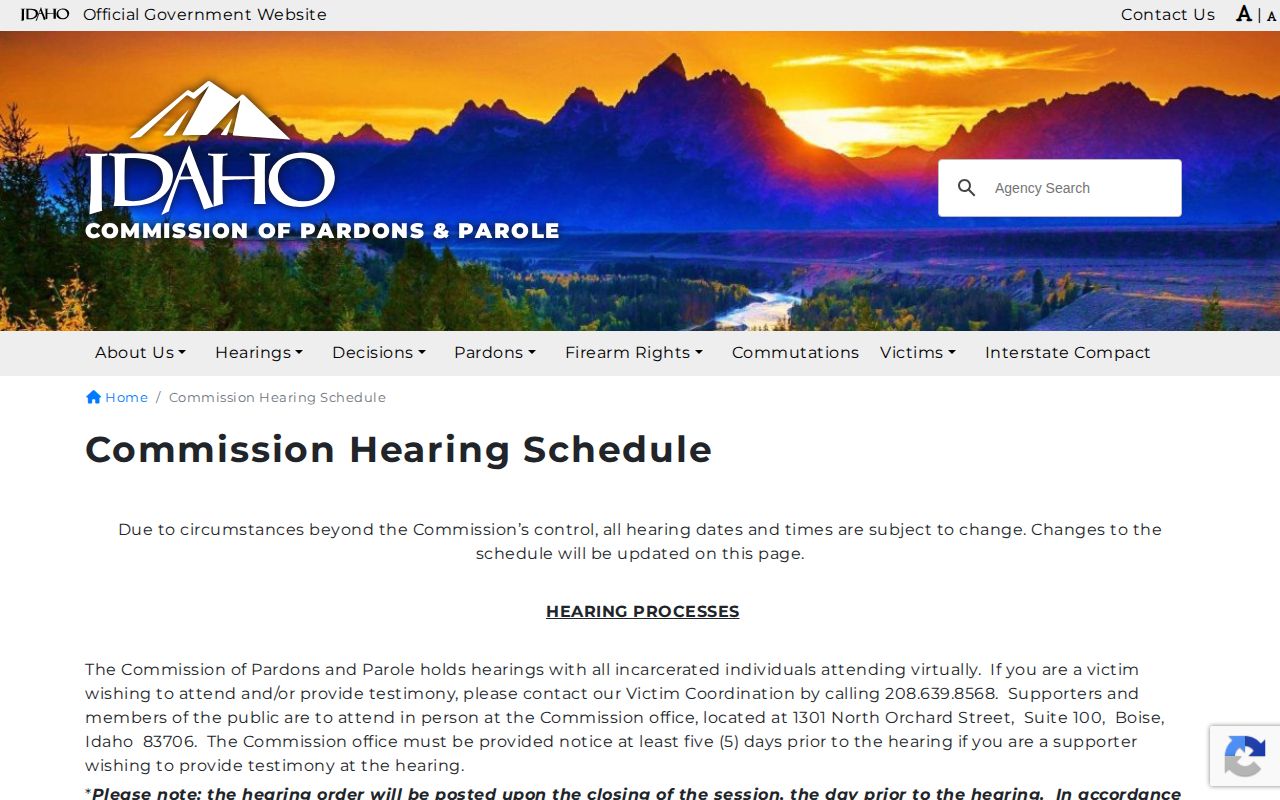
The schedule shows cadence and hearing organization, not proof of a completed release.
Three Bonner Supervision Authorities
Bonner County has three distinct authority layers. The Commission decides state parole. IDOC District 1 supervises felony parole and felony probation. Bonner County Justice Services supervises adult misdemeanor probation. Route the inquiry by sentence type and case number. Calling a generic “probation office” can lead to the wrong record holder.
The Commission's notice answers whether parole was granted, denied, continued, or reconsidered. It does not supervise a person and does not prove that the person walked out on the tentative date. An IDOC detail result showing In community and Released to Supervision supplies the later implementation evidence. For a misdemeanor, the sentencing order and Justice Services record control instead.
VINE may provide custody-event alerts, but it is not the formal supervision ledger. The court docket explains the sentence. IDOC or Justice Services explains current supervision. The sheriff explains current jail custody and release from its facility. Keeping those facts separate avoids treating release from one agency as freedom from every form of legal control.
Two Bonner Warrant Layers
The Sheriff and IDOC publish different warrant signals. Bonner's felony and misdemeanor lists are county law-enforcement tools, time-stamped around the nightly update and expressly incomplete for juveniles. IDOC's Active Bench Warrant label belongs to a state client record and can reflect an unresolved supervision matter. Neither source, standing alone, says where the person is now.
Do not turn either result into a custody claim. Check the Sheriff's current inmate report for present adult county custody, then confirm a warrant through law enforcement or the issuing court. For an IDOC client, use the official Fugitive Recovery channel. The distinction is especially important after release because a person can remain outside jail while a warrant exists, or can be held by another agency without appearing on Bonner's current list.
Reading a Supervision Detail Record
Record each IDOC field without converting it into a broader conclusion. Released to Supervision is the most recent placement on a supervision period by the court or Commission. Sentence Satisfaction Date concerns the active state sentence. Parole Eligibility Date concerns possible consideration, not a promised exit. Multiple sentence rows may have different counties, cases, and statuses.
For a careful verification note, identify the system, the date checked, the name or IDOC number used, the overall status, and the relevant case row. Avoid publishing an officer's dynamic assignment or a client's private details when a simple status confirmation is enough. If the public record appears inconsistent, the District 1 office can route a correction inquiry, though staff may limit disclosure.
Match the Status to the Sentence
A Bonner County name can appear in more than one public system because the underlying legal matters are different. The IDOC search covers people on court probation as well as people under IDOC jurisdiction, including parole clients. Bonner Justice Services covers the local adult misdemeanor track. The Sheriff's records cover detention and warrants, while iCourt supplies the case docket. Search results should be reconciled through the sentencing county and case number rather than combined into one generic supervision history.
An IDOC result of In community does not reveal the person's present address and should not be used to infer it. It establishes that the state system classifies the client outside prison under community supervision. Discharged with a date answers a different question: the displayed state sentence has been satisfied. IDOC says former clients can remain searchable after satisfaction even though old conviction information no longer appears. That is why the absence of sentence rows should not be described as an error or as proof that no sentence existed.
For a county misdemeanor, review the Bonner court order for the imposed term and contact Justice Services at 4002 Samuelson Avenue, Sandpoint, when the inquiry is appropriate. Its posted office hours are 7 a.m. to 5 p.m., and its main phone is 208-263-1602. Do not send an adult misdemeanor inquiry to the Commission merely because the word probation appears in the order.
From Parole Grant to Community Status
A Commission Notice of Action Taken records the decision made at a parole proceeding. A Grant Parole outcome can include a tentative date, but Idaho requires follow-through before release. Required programming, an approved parole plan, and finalized paperwork may remain. A decision word and a date therefore should be reported as a decision, not as a completed release from custody.
After the tentative date, check the IDOC detail page for an overall In community status and the Released to Supervision field. If the record still says In custody, do not assume the public display is wrong or calculate a new date. Confirm through the responsible state office. When the notice says parole to a detainer only, check the named receiving system because the person may move directly into another agency's custody.
This sequence preserves the distinction among eligibility, approval, implementation, supervision, and final sentence satisfaction. Each stage has a different record holder and none should be substituted for the next.